Double jeopardy rule
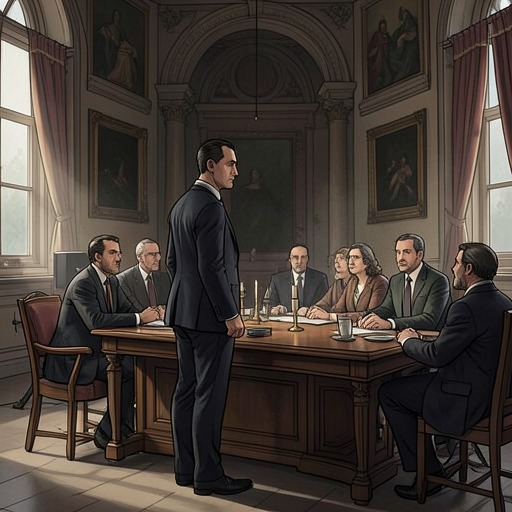
The Mysterious Affair at StylesThe Double jeopardy rule, as Hercule Poirot explains it, bars a person who has been acquitted from being tried again for the same offense. In the investigation of Emily Inglethorp’s death, the principle turns an apparently incriminating case into a possible strategy: Poirot concludes that Alfred Inglethorp wanted to be arrested, confident that an acquittal would make him safe from prosecution for the murder thereafter.
The Rule and the Inheritance Dispute
The rule enters a story already shaped by the legal effects of marriage on inheritance. John Cavendish says that Emily Inglethorp’s August will had left her entire fortune to him, with the arrangement understood as fair because he inherited Styles Court and Lawrence Cavendish was due a considerable sum under their father’s will. Poirot points out that English law automatically revoked that will when Emily remarried, and Mr. Wells confirms that it is null and void. The exchange establishes that legal rules can change the force of a document even when the family has treated its provisions as settled.
The same issue resurfaces at John’s trial. The defense states that John, formerly a barrister, knew Emily’s earlier will in his favor had been revoked by her remarriage. That knowledge complicates the prosecution’s account of motive: the old will could not simply be treated as a current inheritance awaiting his benefit. The trial also recounts that Emily made a new will after a quarrel with John, and that it was found destroyed in her bedroom grate the following morning. Inheritance law, the competing wills, and the destruction of the new document all make legal status central to the case, but the rule against a second trial has a different and more immediate consequence for Poirot’s reasoning.
The Manufactured Case
At the inquest, a young witness says that he sold strychnine to Mr. Inglethorp. Alfred’s apparent connection to the poison seems damning, but Poirot judges the evidence too conclusive. He reasons that a criminal has manufactured it so conspicuously that the apparent strength of the case defeats its purpose: while vague evidence might be difficult to disprove, a tightly constructed accusation can be cut through and used to free Inglethorp.
The trial shows how uncertain that apparent proof remains. The prosecution claims that John bought strychnine while disguised as Alfred, while handwriting experts say the signature in the chemist’s register is not Alfred’s and might be John’s—or might be a clever counterfeit. The defense emphasizes that the poison was found in an unlocked drawer and asks why a guilty person would leave evidence there for a week. These details demonstrate the instability of evidence that initially appears to point in one clear direction. The prosecution’s case against John is not the rule itself, but the competing explanations help establish the novel’s distinction between an accusation strong enough to secure arrest and a case reliable enough to establish guilt.
Poirot’s Deduction and the Rule’s Consequence
Poirot connects the legal protection against retrial to Alfred’s behavior. After discovering that the village rumor concerned John’s attraction to Mrs. Raikes, not an affair involving Alfred, Poirot reinterprets Alfred’s silence. He concludes that Alfred wanted to be arrested. His plan, as Poirot reconstructs it, was to arrange manufactured evidence against himself, produce an unanswerable alibi, and be acquitted; the rule would then prevent another trial for the same offense. A staged prosecution would thus serve not to convict Alfred but to secure his lasting protection.
That deduction changes the meaning of the evidence. Alfred’s apparent implication in the poison purchase is no longer simply a sign of guilt or a clumsy attempt at concealment: in Poirot’s account, it is part of a calculated scheme designed to end in acquittal. The rule is therefore more than background law. It supplies the strategic payoff that makes the manufactured case intelligible and explains why Poirot is determined not to let Alfred be arrested on terms that could make him immune to a later, genuine prosecution.